A continuous rodent defense strategy requires rigid physical barriers rather than cyclical poison baiting. In Greenville properties, mice squeeze through openings as narrow as 0.25 inches, while mature roof rats enter…
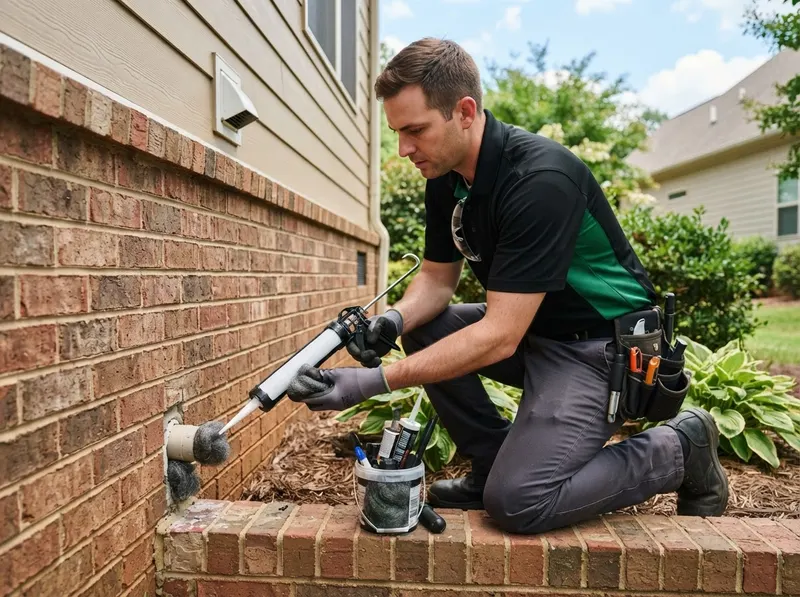
A continuous rodent defense strategy requires rigid physical barriers rather than cyclical poison baiting. In Greenville properties, mice squeeze through openings as narrow as 0.25 inches, while mature roof rats enter gaps measuring 0.5 inches wide, as noted by the Centers for Disease Control and Prevention. IronCove Pest Protection installs heavy-gauge barrier materials to terminate ingress corridors. Field installations use industrial 19-gauge hot-dipped galvanized hardware cloth, copper mesh, and elastomeric sealants meeting ASTM International durability benchmarks to close HVAC line-set passages, weep screeds, crawlspace vents, and roofline soffit intersections.
Crawlspace architecture and older hardwood framing across established Greenville neighborhoods demand custom mechanical sealing. In historic crawlspaces near Alta Vista, North Main, and Overbrook, red clay soil settling frequently detaches masonry foundation skirts, opening subterranean tunnels that rodents navigate directly into subflooring. Foundation specialists anchor rigid wire mesh directly into brick and stone mortar according to International Code Council guidelines for residential crawlspace closures. Meanwhile, in newer slab-on-grade developments throughout Verdae and Gower Estates, plumbing chases and multi-unit utility sleeves beneath sheetrock present unseen entry zones that require mechanical expansion sleeves and fire-rated sealants verified under UL Standards.
Roof rats utilize tree canopies along the Reedy River and mature oak corridors in Parkins Mill, Chanticleer, and Botany Woods to access high-elevation junctions. These rodents travel across overhead power drops, bridging into attic spaces through fascia corners, ridge vents, and gable louvers. Standard spray foams fail because rodents chew through soft polyurethane inside 48 hours; mechanical exclusion replaces temporary fillers with fabricated sheet metal flashing conforming to structural standards from the International Association of Certified Home Inspectors. Sealing high-elevation entry points protects attic insulation from rodent urine contamination and eliminates fire hazards caused by exposed, gnawed electrical wiring governed by the National Fire Protection Association.
Executing exclusion requires a chronological multi-phase deployment. Phase one documents all structural deficiencies via exterior mapping and thermal imaging of exterior walls. Phase two installs physical barriers across exterior foundations, crawlspace vents, and roof terminations. Phase three places interior mechanical capture systems within utility chases to remove any animals trapped inside the thermal envelope, in alignment with recommendations from the National Pest Management Association and wildlife management policies maintained by the South Carolina Department of Natural Resources. Finally, phase four audits all seal points and crawlspace vapor barriers to confirm zero air infiltration along structural sills, satisfying environmental containment criteria from the Environmental Protection Agency and state oversight from the Clemson University Department of Pesticide Regulation.
Every job gets a firm, written price after a free on-site visit.
Tell us about your rodent exclusion and mechanical sealing job in Greenville and we'll send a clear, written quote, usually the same day.
 IronCove Pest Protection