Subterranean termite structural defense in Greenville, SC addresses the Eastern subterranean termite, a pest endemic across the Piedmont clay soils of Greenville County. Unlike drywood varieties that live exclusively…
Subterranean termite structural defense in Greenville, SC addresses the Eastern subterranean termite, a pest endemic across the Piedmont clay soils of Greenville County. Unlike drywood varieties that live exclusively inside seasoned lumber, subterranean colonies nest deep below the surface and construct exploratory shelter tubes out of soil and salivary secretions to span foundation masonry. Older crawlspace framing throughout North Main, Augusta Road, and Overbrook routinely sits adjacent to moist backfill, creating an accessible path for foraging insects. Standard aerosol or baseboard spraying fails to suppress subterranean termites because it kills only individual surface foragers, leaving thousands of colony members inside subterranean chambers intact. Complete control requires disrupting the perimeter soil or installing an interception matrix that workers transport back to the primary reproductive caste.
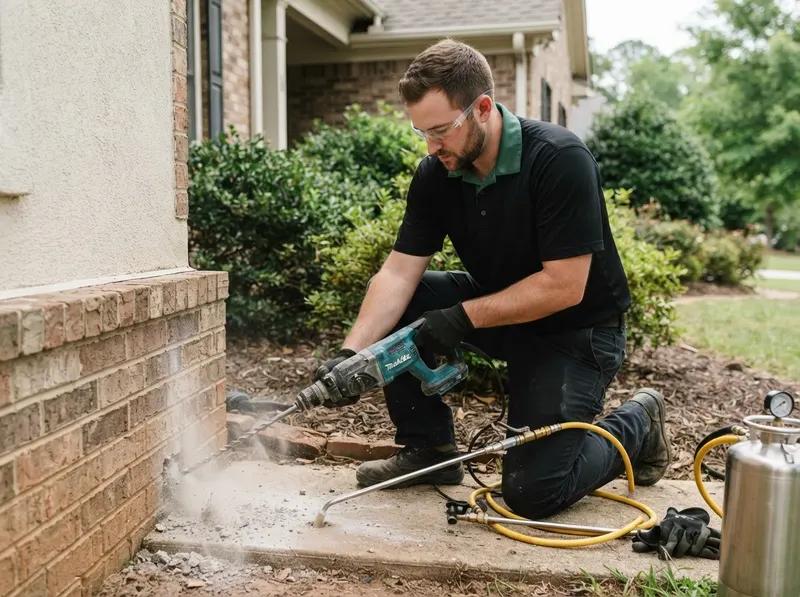
Technicians implement two primary defensive options: continuous liquid soil treatments or targeted exterior bait stations. Liquid termiticides, formulated with non-repellent compounds evaluated by the EPA Office of Pesticide Programs, involve trenching a 6-inch by 6-inch channel into soil against foundation stem walls and rod-injecting beneath abutting concrete slabs. Foraging termites walk through the treated substrate without detecting the active agent, transferring the lethal dose to nestmates through grooming behavior governed under standard Clemson University Department of Pesticide Regulation application mandates. Alternatively, structural defense using direct monitoring stations incorporates non-repellent chitin synthesis inhibitors documented by the USDA Agricultural Research Service. In properties throughout Chanticleer and Alta Vista where dense landscaping, mature root zones, or sloping topographies along the Reedy River watershed limit soil excavation, bait systems intercept colonies through exterior cylinders driven flush with grade every 10 to 15 feet.
Choosing between perimeter liquid barriers and subterranean bait networks involves structural trade-offs. Liquid chemistry creates an immediate perimeter exclusion field around brick piers and perimeter footings, but concrete drilling through patio slabs, covered entryways, or brick ledger boards is mandatory to establish an unbroken envelope. Bait networks require zero structural drilling through decorative masonry, which preserves historic masonry in neighborhoods like Gower Estates and Botany Woods; however, bait relies on natural insect foraging cycles and requires seasonal inspections to ensure replenishment. The US Forest Service Wood Products Laboratory notes that subterranean species cause significant property damage across the Southeast when moisture barriers are absent. Pairing perimeter defensive chemistry with continuous crawlspace ground covers complying with the International Residential Code foundation moisture guidelines limits wood equilibrium moisture, removing the primary catalyst that invites subterranean swarms into sills, floor joists, and stud plates.
Foundation construction directly governs installation methodology. Monolithic slab foundations standard in newer developments around Verdae and Parkins Mill possess expansion joints, plumbing penetrations, and bath traps that allow subterranean termites to enter directly from below the slab without building external shelter tubes. For these homes, sub-slab injection utilizing calibrated flow meters guarantees uniform coverage beneath concrete foundations. Properties near natural humidity corridors, such as Paris Mountain State Park or the low-lying sections of the Swamp Rabbit Trail, face heightened structural termite pressure due to sustained soil dampness. IronCove Pest Protection utilizes calibrated high-pressure delivery systems, abiding by technical safety standards outlined by the Occupational Safety and Health Administration and pest mitigation strategies referenced by the National Pest Management Association. Property owners can call (864) 215-5084 to coordinate a systematic perimeter inspection.
Every job gets a firm, written price after a free on-site visit.
Tell us about your subterranean termite structural defense job in Greenville and we'll send a clear, written quote, usually the same day.
 IronCove Pest Protection